

Turning Farm Residue into a Menstrual Hygiene Solution
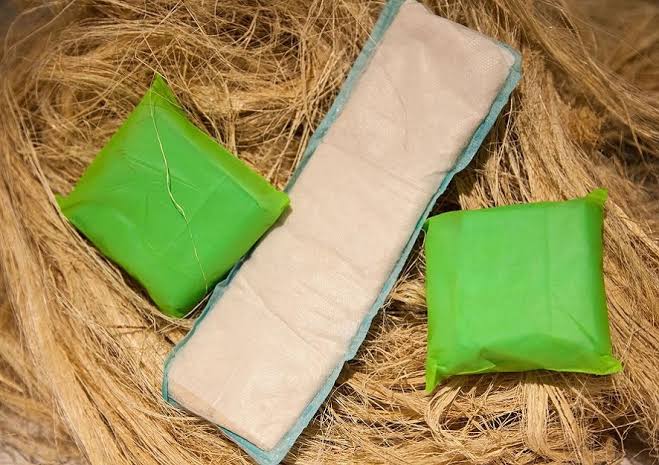
What if the banana plant could offer more than its fruit?
At Chuka University, students in the Department of Plant Sciences are exploring an answer by turning banana fibre, an agricultural by-product, into sanitary pads. The innovation, Safe Sanitary Pads from Banana Fibre, was presented during the 5th Tharaka University Career, Innovation and Entrepreneurship Week (CIEW) 2026, held from March 4–6 under the theme “Catalyzing Economic Growth through Innovation and Entrepreneurship.” It emerged as the Best Innovation at the event.
The idea brings together three pressing concerns: menstrual hygiene, agricultural waste and environmental sustainability. Rather than allowing banana fibre to remain an underutilised farm by-product, the students are exploring how it can be converted into a useful menstrual hygiene product that is safe, affordable and biodegradable. According to the project report, innovation also has potential to create economic opportunities for farmers, support agricultural value chains and generate rural employment.
Why Banana Fibre?
After a banana bunch is harvested, the pseudostem, the thick, layered structure commonly mistaken for the plant's trunk, is usually left behind. Yet this material contains significant amounts of cellulose, the structural component that gives plant fibres their strength.
Research has shown that banana pseudostem can be mechanically processed to extract fibre. Depending on the variety and extraction method, the fibre can be obtained through processes such as decortication, in which the pseudostem is scraped or mechanically processed to separate the fibre from the softer plant material. Studies have found cellulose to be a major component of banana pseudostem fibre.
This cellulose-rich material is what makes banana fibre interesting for absorbent products.
Researchers have been investigating banana and plantain pseudostem as alternatives to conventional absorbent materials in sanitary pads. The Chuka University innovation builds on this broader idea: turning an agricultural residue into a product with social and economic value.
The Process of Making the Sanitary Pads from the Pseudostem
The journey begins with extracting fibre from the banana pseudostem. The extracted fibre is then cut into smaller pieces before undergoing boiling and cleaning. It is washed and dried before being processed further through pulping.
Once the fibre has been prepared and pulped, it is used to make the different layers of the pad. The students then bind the layers together to form the finished product of the right shape. After shaping the pad, the finished product is sterilised and packaged, ready for the next stage towards the market.
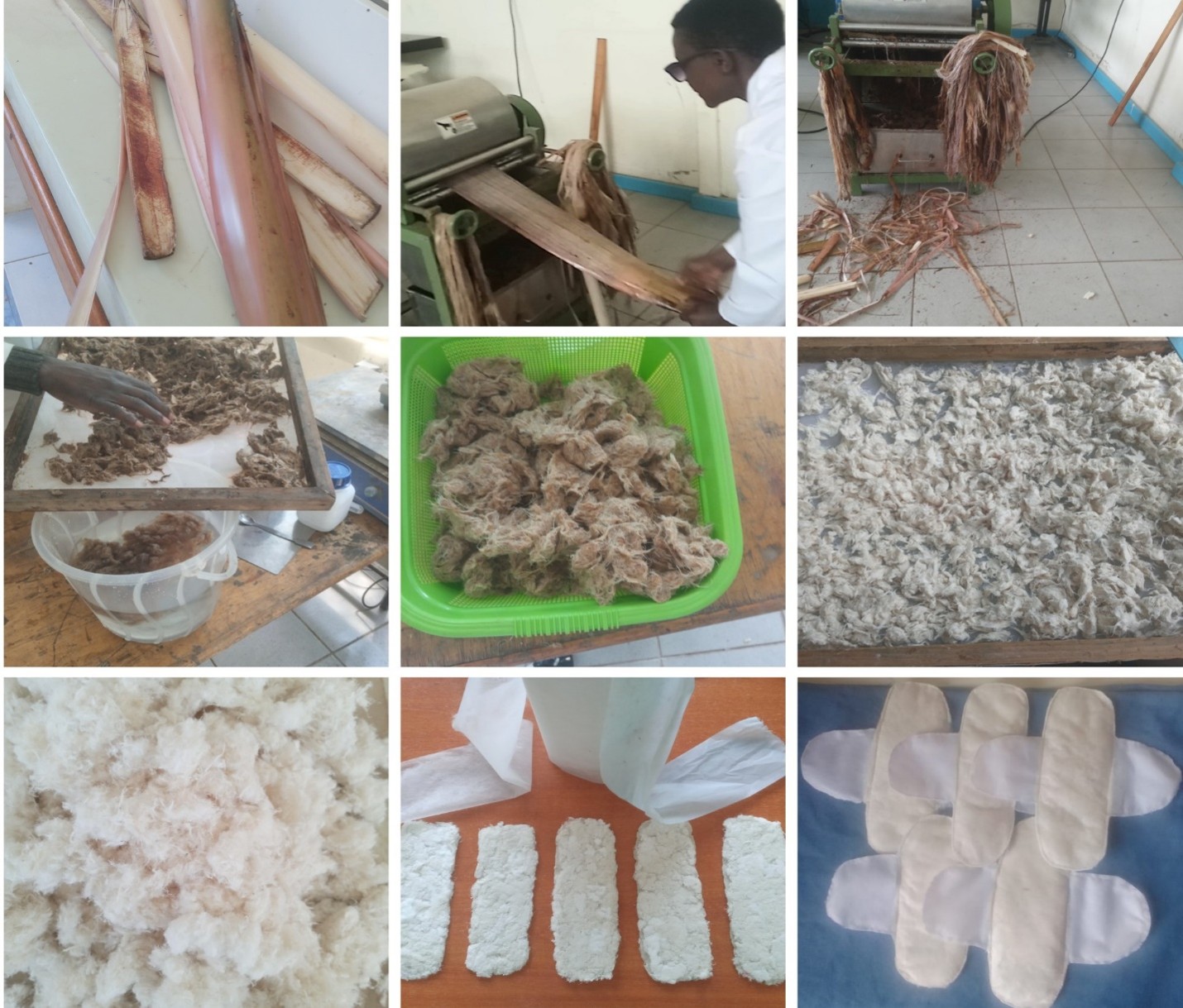
This approach is significant because the innovation is not simply about finding another use for banana waste. It is about taking something that is readily available in farming communities and processing it into a product designed to meet an everyday need.
More than a Sanitary Pad
The significance of the Chuka University innovation extends beyond the product itself. The project report describes the pads as eco-friendly because they are made from sustainable and biodegradable materials. It also positions the innovation as a response to the waste generated by conventional plastic-based sanitary pads.
There is also a clear social dimension. The students are targeting girls aged 12–24 in semi-urban and rural areas, particularly those who struggle to access affordable sanitary pads. The project aims to respond to this need while tapping into growing interest in environmentally friendly menstrual products.
This innovation creates a circular economy opportunity for farmers, as a farmer grows bananas for the fruit and the pseudostem is processed and converted into a useful product.
This has several potential benefits, including creating additional economic opportunities for local farmers, supporting agricultural value chains, promoting rural employment and contributing to sustainable agriculture and environmental conservation.
This opens up an intriguing possibility for banana-growing communities. Instead of viewing the pseudostem simply as farm residue, it can be considered a resource with potential applications in fibre, paper, textiles and absorbent products.
An Innovation with Room to Grow
The students have already moved beyond the idea stage and begun production. However, the product is yet to reach the market as the team awaits approval from the Kenya Bureau of Standards (KEBS) and completion of other legal requirements.
The project will require investment in equipment, raw materials, labour, utilities, marketing and advertising to support production, packaging and distribution. The students envision a facility capable of taking the product through these stages as they work towards serving the feminine hygiene market.
The innovation therefore still has a journey ahead. Questions around production capacity, affordability, market acceptance and compliance will need to be addressed as the product moves towards commercialisation.
What it already demonstrates, however, is the potential of agricultural value addition to solve problems beyond food and income. By taking banana fibre from the farm and exploring its use in menstrual hygiene products, the students have connected agricultural waste management with environmental sustainability, innovation and enterprise.
The next step is to move from an award-winning innovation to a thoroughly tested, approved and commercially viable product. If that journey succeeds, a material once viewed as agricultural waste could become part of a solution to an everyday need, while creating another reason to see value not only in what farmers harvest, but also in what they leave behind.
Total comments (--)
Let others know what you think



Lorem ipsum dolor sit amet, consectetur adipiscing elit. Suspendisse varius enim in eros elementum tristique. Duis cursus, mi quis viverra ornare, eros dolor interdum nulla, ut commodo diam libero vitae erat. Aenean faucibus nibh et justo cursus id rutrum lorem imperdiet. Nunc ut sem vitae risus tristique posuere.