

Chuka University Exemplifies the Role of Universities as Catalysts for Community Transformation Through Agriculture
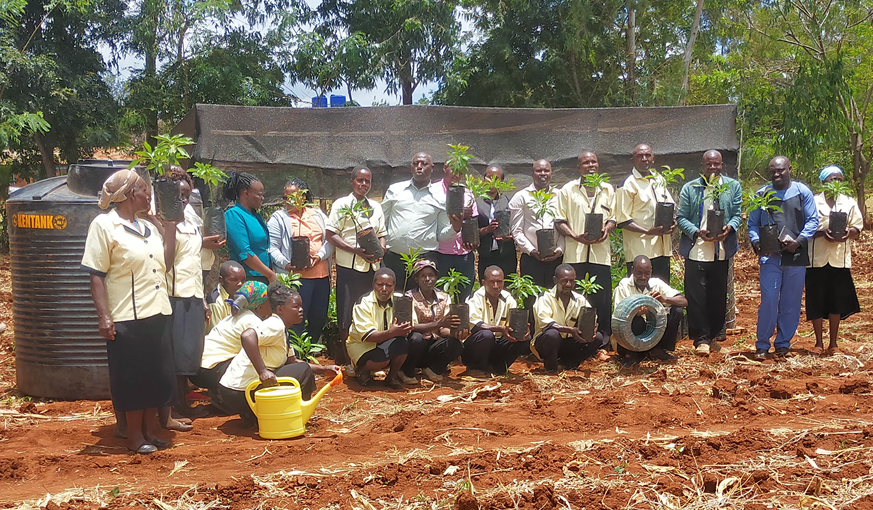
Universities are increasingly playing a vital role beyond teaching and research by directly transforming the communities around them through practical agricultural solutions. In Kenya’s Tharaka Nithi County, Chuka University is demonstrating how institutions of higher learning can bridge the gap between research and real-life farming challenges to improve livelihoods, food security, and environmental conservation.
Through a project titled Building Resilience of Small-Scale Farmers’ Production Systems Through Dissemination of Climate Smart Agricultural Technologies for Enhanced Global Food Supply Chains and Improved Biodiversity in Tharaka-Nithi County, the university is working closely with local farmers to promote climate-smart agriculture and sustainable food systems.
At the center of the initiative is the establishment of four Farmer Field Schools (FFS) in Chuka and Igambang’ombe sub-counties. These field schools serve as practical
learning centers where farmers, students, lecturers, and researchers come together to share knowledge and test agricultural innovations that can improve productivity while protecting the environment.
The project focuses on integrating agroforestry into farming systems through the planting of grafted Hass avocado and apple mango trees. By promoting fruit tree
farming alongside conventional crops, the university is helping farmers diversify income sources, improve nutrition, and build resilience against climate change.
The initiative has brought together 100 smallholder farmers organized into four Self-Help Groups: Mbuti SHG, Kiramba SHG, Mwangaza SHG, and Nthima NAALAP SHG.
These groups also operate as Farmer Participatory Research groups, allowing farmers to actively participate in testing and adapting technologies suited to their local conditions.
One of the most impactful aspects of the project is the establishment of a community-based fruit tree nursery that doubles as a Farmer Field School. The demonstration site provides hands-on training on climate-smart agricultural practices such as agroforestry, conservation agriculture, crop rotation, integrated pest management, ecosystem conservation, and sustainable soil management. Through this approach, the university
is not only transferring knowledge but also empowering communities with practical skills that can increase farm productivity and household incomes.
The Farmer Field School model has also strengthened the relationship between the university and the surrounding community. Students and faculty members gain practical
field experience while farmers benefit from direct access to scientific knowledge and improved technologies. This creates a two-way learning process where academic research is shaped by real community needs.
Following the success of the first two phases of the project, Chuka University secured additional funding under Phase III to expand fruit tree propagation and strengthen the
existing nurseries. The support enabled the purchase of grafted Hass avocado and apple mango seedlings, construction materials for nursery expansion, shade nets, potting bags, timber, and other essential inputs.
The project also supported farmer training sessions, field activities for students and faculty, and farmer group coordination. Farmers were further trained on nursery
management, seedling care, and techniques for scaling up fruit production for commercial purposes.
By supporting smallholder farmers with knowledge, quality planting materials, and practical training, Chuka University is helping transform agriculture from subsistence
farming into a more sustainable and income-generating enterprise. At the same time, the project contributes to biodiversity conservation, climate change mitigation, and stronger local food systems.
The initiative highlights the growing importance of universities as drivers of rural development. Beyond producing graduates, institutions like Chuka University are
becoming centers of innovation, community empowerment, and sustainable agricultural transformation.
Article Written By: Prof. Geoffrey Gathungu and Dr. Martin Njogu
Total comments (--)
Let others know what you think

Lorem ipsum dolor sit amet, consectetur adipiscing elit. Suspendisse varius enim in eros elementum tristique. Duis cursus, mi quis viverra ornare, eros dolor interdum nulla, ut commodo diam libero vitae erat. Aenean faucibus nibh et justo cursus id rutrum lorem imperdiet. Nunc ut sem vitae risus tristique posuere.



Lorem ipsum dolor sit amet, consectetur adipiscing elit. Suspendisse varius enim in eros elementum tristique. Duis cursus, mi quis viverra ornare, eros dolor interdum nulla, ut commodo diam libero vitae erat. Aenean faucibus nibh et justo cursus id rutrum lorem imperdiet. Nunc ut sem vitae risus tristique posuere.