

The Value of Rabbit Keeping Beyond its Products
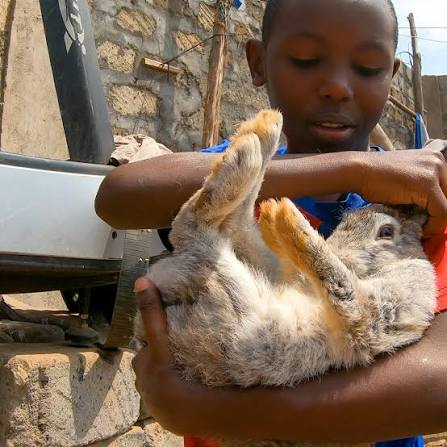
I recently listened to a young man who referred to his secondary school experience as having made him the responsible man he is today. The greatest lessons he learnt were on the school farms, especially because as students, they were assigned responsibilities beyond cleaning schedules; sometimes, they would be put in charge of the pigs reared in the school. If the Sow was pregnant, they would be tasked with tending to it through its pregnancy, to delivery and subsequently catering for the kid. “The awareness that the animal depends on you for survival makes you responsible,” he said. Among many other rotational duties, the men that graduated from this school have gone out to be diligent and responsible enough to take up challenging projects to completion.
This prompts the question: how can other schools leverage such opportunities to nurture well-rounded learners? Young adults who see animals not merely as a source of amusement, but as livestock that, when well cared for, can provide good returns. Learners who understand the value of the animals kept at home and appreciate their potential as a source of food and income.

Rabbits as a lesson in responsibility
Rabbits are social animals and rabbit keeping can involve people of different ages and genders. For children, the enterprise offers something difficult to teach through textbooks alone, responsibility through routine.
Someone has to feed the rabbits. Someone has to clean the hutches. Someone has to collect weeds and suitable fodder. Someone has to check on the young ones and ensure they are suckling properly. These may seem like small tasks but they are not.
They teach children to show up, care for something and finish what they started. That is why school clubs such as 4K Clubs, Young Farmers Clubs and Science Clubs can be encouraged to take up rabbit production. A well-managed rabbit unit keeps students meaningfully occupied while giving them practical agricultural and entrepreneurial skills.
Additionally, students can construct rabbit hutches using locally available materials. Grass can be used for roofing and nesting, while suitable herbs and shrubs can provide materials for construction and fodder. In the process, students learn basic building skills while keeping the school compound neat.
The work does not stop at the hutch. Students can be involved in feeding, cleaning, caring for young rabbits and using the manure and urine to grow vegetables. They begin to see the connection between animals, crops, waste and food.
That is agroecology in practice, not just a lesson on a blackboard. Institutions that grow vegetables such as kale, spinach, cabbage and carrots can use some of the crop residues and kitchen leftovers as feed. The rabbits, in turn, provide manure and urine that can be used in vegetable production and integrated pest management.

Social Benefits
Schools can work with neighbouring institutions to exchange breeding bucks. This reduces the risk of inbreeding while improving productivity. Such exchanges create opportunities for students and institutions to interact, share knowledge and build friendships. A rabbit project can quietly become a bridge between neighbouring schools and communities.
Children are also quick to pick up new technologies and ideas. What they learn at school can travel home, reaching parents and siblings and potentially increasing adoption of better farming practices.
The rabbit, in other words, becomes a teaching tool, a way of recycling farm waste while providing a source of food. Most importantly, it becomes a reason for children to take responsibility for something that depends on them every day.
Total comments (--)
Let others know what you think

The Same Author


Lorem ipsum dolor sit amet, consectetur adipiscing elit. Suspendisse varius enim in eros elementum tristique. Duis cursus, mi quis viverra ornare, eros dolor interdum nulla, ut commodo diam libero vitae erat. Aenean faucibus nibh et justo cursus id rutrum lorem imperdiet. Nunc ut sem vitae risus tristique posuere.